
Email: belinda@belindacoghlan.com.au | Phone: 0414 642 921
Perth-based Psychological Safety Consulting
WHAT
is Psychological Safety Consulting?
Psychological safety is the belief that you won't be punished, humiliated or ignored for speaking up - with an idea, a question, a concern, a mistake. [Amy Edmondson]
Let’s be clear, psychological safety is not about being nice or a shield for poor performance or accountability. Radical candour given in a psychologically safe way, is a gift for growth.
When the risk of speaking up is too high, people stay quiet. Problems, risks and good ideas all stay hidden until they become expensive.
Most organisations try to fix this with a single workshop or a poster. It doesn't work, because psychological safety isn't a feeling you can talk people into, it's a system you build, measure and maintain.
I built the Psychological Safety System Blueprint™ to do exactly that: a practical, evidence-based framework for systemising psychological safety, rather than treating it as a one-off culture initiative.
WHO
needs Psychological Safety Consulting?
Almost every organisation reaches a point where silence is costing more than the truth would.
Why? Because the organisations I work with are usually facing one or more of the same warning signs.
⮽ Staff who stay quiet about mistakes, risks or concerns until something goes wrong
⮽ Leaders who get “surprised” by problems that plenty of people saw coming
⮽ Leadership lacking a growth mindset
⮽ Unclear expectations on safe behaviours
⮽ High performing “toxic rockstars” whose results excuse their behaviour
⮽ Rising presenteeism, quiet quitting, sick leave or turnover with no clear single cause
⮽ A culture, wellbeing or engagement survey that keeps returning the same disappointing results
⮽ Psychosocial hazards that are documented but not actually reducing risk
⮽ A safety incident that has WorkSafe knocking on your door.
HOW
does Psychological Safety Consulting work?
Whatever's brought you here, if silence has become the safest option in your workplace, I'm here when you need me. My Psychological Safety System Blueprint™ has four pillars, each addressing a different layer of the system, moving an organisation from fearful to fearless:
Apply Neuro-Emotional Needs
Understanding the brain science of psychological threat - security, autonomy, fairness, esteem and trust - and building brain-safe workplace conditions that are neurodivergent-aware and trauma-informed from the ground up, not as an afterthought.
Protect Critical Risk
Safe reporting channels, staff consultation and risk assessment, with clear measurement and improvement targets, so you know whether people actually feel safe raising a concern, not just whether a policy exists.
Uplift Organisational Capability
Psychologically safe behaviours, built through upstander skills, healthy boundary conversations and feedback that lands, makes speaking up possible in practice.
Engineer Accountable Guardrails
Core values, policies and procedures, leadership performance metrics, and real positive and negative consequences
applied consistently. This includes high performers whose behaviour has previously been excused.

Where does your organisation sit on the maturity scale for a psychological safety system?
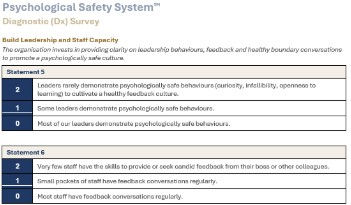
A great place to start is our very own Psychological Safety System™ Diagnostic (Dx) Survey - a structured assessment across all four pillars that gives you a Workplace Maturity Score.
Start the journey now, by completing the Psychological Safety System Dx Survey.
Do your suspect there are hotspots of poor team psychological safety in your organisation but don’t have any evidence?
We can assess and debrief your team using global expert, Amy Edmondson’s 7 Question Survey. The survey evaluates how comfortable team members feel taking interpersonal risks without fear of negative consequences.
Are you a leader who would like to understand and address how individual’s psychological safety?
Each team member can complete Amy Edmondson’s free personal psychological safety survey here.
We can facilitate a debrief session on the results and develop an action plan with your team.
Are you experiencing a rise in staff using psychological safety to avoid accountability for their performance?
We can help your leaders assess their teams and move towards a high-performance team culture in the learning zone; one where people feel safe speaking up and accountable for delivering.
Amy Edmondson’s Model of Psychological Safety and Accountability

Sources: Edmondson, A. C. (1999). Psychological Safety and Learning Behavior in Work Teams. Administrative Science Quarterly, 44(2), 350–383.
Edmondson, A. C. (2018). The Fearless Organization: Creating Psychological Safety in the Workplace for Learning, Innovation, and Growth. Wiley.
WHERE
to apply Psychological Safety Consulting
Wherever people are holding back, important issues are staying unspoken, or leaders are hearing about problems too late.
Psychological safety consulting can make a difference in workplaces experiencing:
-
Low trust or fear of speaking up - where people stay silent, avoid difficult conversations or fear the consequences of raising concerns.
-
Psychosocial risks - including bullying, poor workplace relationships, excessive demands, poor support or other factors affecting psychological health.
-
Leadership or culture challenges - where leadership behaviours, workplace norms or cultural patterns are discouraging openness and accountability.
-
Change, restructuring or growth - when uncertainty makes communication, trust and speaking up particularly important.
-
Recurring workplace issues - where problems keep resurfacing because people aren't comfortable challenging, reporting or addressing them early.
-
High-risk or high-accountability environments - where speaking up about safety, conduct, performance or operational risks can prevent serious consequences.
Psychological safety also threads through my broader consulting work underpinning Human Skills Training, strengthening WHS Psychosocial Risk Audits and supporting a Workplace Culture Review and Culture Change Consulting where fear, silence or low trust are contributing to deeper cultural issues.
WHY
choose me?
I'm the founder of the Psychological Safety System Blueprint™, a certified assessor for the Barrett Values Centre Culture Values Assessment (CVA) and the Academy of Brain-Based Leadership Psychological S.A.F.E.T.Y.® Model.
My approach draws on the neuroscience of psychological threat and safety, as well as trauma-informed leadership principles. It recognises that a meaningful proportion of any workforce is carrying an unseen history of stress or trauma that shapes how safe they feel speaking up, whether or not it's ever disclosed.
I am a firm believer that for accountability, leaders must have clarity on the behavioural expectations of psychological safety, develop self-awareness on how they show up with teams, set improvement goals and measure and report on their team’s psychological safety.
As you can see from the blueprint, this work is systemised, measured and accountable, because if you can't measure whether psychological safety has improved, you can't confidently say that it has.
Frequently Asked Questions
Is this the same as a psychosocial risk audit?
They're closely linked but different in scope. The audit is a compliance-focused WHS process, measuring and documenting hazards against legislation. Psychological Safety Consulting is the broader system-building work - culture, leadership behaviour, work design and guardrails - that an audit's findings often point back to.
What's the Diagnostic (Dx) Survey?
A structured self-assessment across all four Blueprint pillars, giving you a Workplace Maturity Score from early maturity through to a genuinely mature, psychologically safe workplace. It's the starting point for every engagement, so recommendations are grounded in where you are, not a generic checklist.
How is this different from an engagement survey?
Engagement surveys measure how people feel about their job. They don't reliably measure whether a workplace is psychologically safe or subtly toxic - a team can report high engagement and still have serious speak-up problems underneath. The Blueprint measures psychological safety specifically.
What if we already have wellbeing and WHS programs in place?
Good - this builds on them rather than replacing them. Psychological safety is often siloed across HR, WHS and team leaders separately. Part of this work is integrating what you already have into one accountable system, rather than adding another disconnected initiative.
Do you work with neurodivergent or trauma-affected staff specifically in mind?
Yes - the Blueprint's neuro-emotional pillar is built to be trauma-informed and neurodivergent-aware from the ground up. A meaningful proportion of any workforce is carrying an unseen history that shapes how safe they feel at work, whether or not it's ever disclosed.
How long does this take?
It depends on your Workplace Maturity Score and scope - from a single Dx Survey and debrief through to a multi-month program working through all four Blueprint pillars.